
Table of Contents
- What Exactly Is a Melatonin Vape?
- Why Would Someone Inhale Melatonin Instead of Just Taking a Gummy?
- Do Melatonin Vapes Actually Work?
- The Safety Question: And Why It Deserves a Straight Answer
- Who Are Melatonin Vapes Actually For?
- Melatonin Vapes vs. Melatonin Gummies vs. Melatonin Pills
- What to Look for When Choosing a Melatonin Vape
- How to Use a Melatonin Vape for Best Results
- The Bottom Line
- FAQs
If you've been curious about melatonin vapes, you're not alone. The category has grown quickly, fueled by people who want something faster than a gummy, more intentional than a sleep spray, and easier to work into a nighttime routine than a pill you have to swallow with water at 10pm. Whether they're right for you depends on a few things most product pages won't tell you, so let's get into the real picture.
Quick Answer: Melatonin vapes are nicotine-free diffuser devices that deliver melatonin through inhalation, designed to support sleep onset faster than traditional oral supplements. They work by bypassing the digestive system for quicker absorption, though the clinical evidence for inhaled melatonin is still emerging. They are not FDA-approved, contain no nicotine, and should be considered a lifestyle product rather than a medical sleep aid.
Key Takeaways
- Melatonin vapes are nicotine-free and contain no addictive substances
- They may absorb faster than oral melatonin due to the lung's large surface area
- Clinical evidence specifically for inhaled melatonin is limited but growing
- A 2025 PubMed study raised concerns about potential contaminants in some products, brand selection matters
- They work best as part of a consistent sleep routine, not as a standalone fix
- Zero-nicotine melatonin diffusers are legal in most U.S. states
What Exactly Is a Melatonin Vape?
The term "melatonin vape" gets used loosely, which causes a lot of confusion. Let's clear it up.
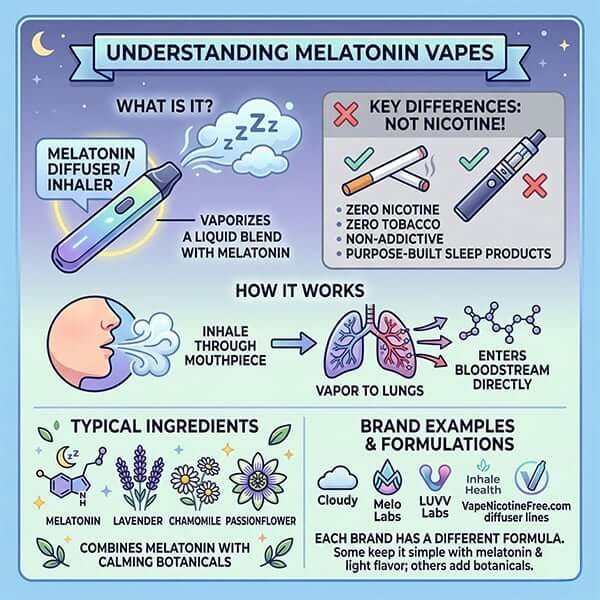
A melatonin vape, more accurately called a melatonin diffuser or melatonin inhaler, is a handheld device that vaporizes a liquid blend containing melatonin and typically a mix of other botanicals like lavender, chamomile, or passionflower. The MELO Plus Melatonin Disposable is a great example of a Melatonin Vape. You inhale through the mouthpiece, and the vapor delivers melatonin directly to your lungs, where it can enter the bloodstream.
What they are not: nicotine vapes with melatonin added. These are purpose-built sleep products with zero nicotine, zero tobacco, and no addictive compounds. The hardware resembles a disposable vape pen, but the intent and the contents are completely different.
Brands currently in this space include Cloudy, Melo Labs, LUVV Labs, Inhale Health, and the melatonin diffuser lines carried at VapeNicotineFree.com. Each approaches the formula slightly differently; some combine melatonin with calming botanicals, others keep it simple with melatonin and a light flavor profile.
Why Would Someone Inhale Melatonin Instead of Just Taking a Gummy?
Fair question. Melatonin gummies work. So why is this category growing?
The answer comes down to speed and convenience. When you swallow a melatonin supplement, it travels through your digestive system before entering your bloodstream. Depending on your metabolism, what you've eaten, and how your gut is functioning that night, onset can take anywhere from 30 minutes to over an hour.
Inhaled melatonin bypasses the digestive system entirely. The lungs have an enormous surface area, roughly the size of a tennis court, and are designed for rapid transfer of compounds into the bloodstream. Proponents argue this makes the onset significantly faster, potentially within minutes rather than half an hour.
For someone who's lying in bed, already restless, already frustrated that sleep isn't coming, that timing difference is meaningful. There's also a behavioral component: the act of using a melatonin diffuser can itself signal to your brain that it's time to wind down. Ritual matters in sleep hygiene, and this gives you something tangible to do as part of a pre-sleep routine.
Do Melatonin Vapes Actually Work?
Here's where intellectual honesty is required.
The case for melatonin itself is solid. Melatonin is one of the most well-studied supplements in existence, with decades of research supporting its role in regulating circadian rhythm and sleep onset. The National Institutes of Health recognizes melatonin as likely effective for jet lag, shift work sleep disruption, and delayed sleep phase syndrome, according to a informational health page published on NIH.
The case for inhaled melatonin specifically is thinner, not because it doesn't work, but because fewer studies exist. The delivery route is newer, the products are relatively recent, and large-scale clinical trials haven't caught up yet.
What early evidence and physiological logic support: the lung's absorption capacity is real and well-documented. Inhaled medications routinely outpace oral ones in speed of action — this is why asthma inhalers work in seconds rather than minutes. Whether the specific amount of melatonin delivered in a diffuser reaches a therapeutically meaningful blood concentration is the open question.
Anecdotally, users consistently report faster sleep onset compared to their experience with gummies or pills. That's not clinical proof, but it's not nothing either, especially when the compound involved is melatonin — a substance your body already produces and is familiar with.
The most honest framing: melatonin vapes appear to work for many people who try them, the physiological mechanism is plausible, and the clinical literature is still catching up. Treat them as a wellness product, not a pharmaceutical sleep aid.
The Safety Question: And Why It Deserves a Straight Answer
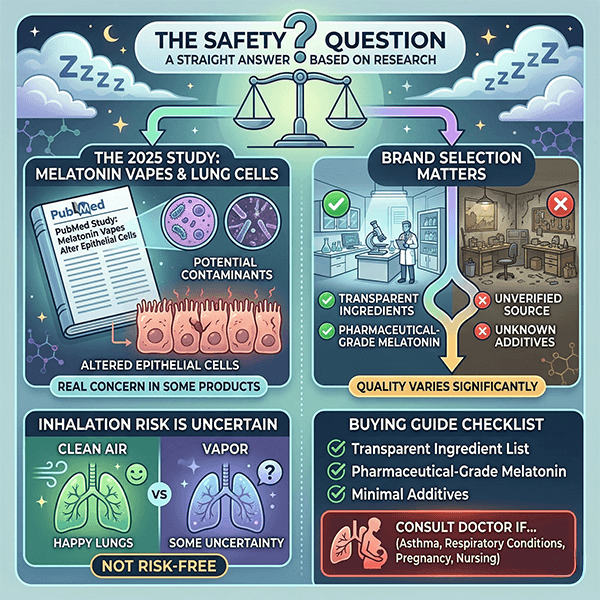
A 2025 study published in PubMed titled "Melatonin Vapes Contain Potential Contaminants and Alter Epithelial Cells" raised legitimate concerns about product quality in the melatonin vape category. The research identified contaminants in some tested products and noted effects on epithelial cells, the cells that line your lungs and airways.
This study deserves to be taken seriously, not dismissed. Anyone selling melatonin vapes who doesn't acknowledge this research is choosing marketing over honesty.
Here's what it means practically: the study does not conclude that all melatonin vapes are dangerous. It highlights that product quality varies significantly across the category, and that contaminants, likely from low-quality manufacturing or ingredient sourcing, are a real concern in some products. This is a brand selection issue as much as a category-wide indictment.
It also reflects something true of any inhalation product: inhaling anything other than clean air carries some level of uncertainty. Zero-nicotine melatonin diffusers eliminate the addiction risk and the combustion toxins of cigarettes, but they are not risk-free. Any honest product guide has to say that clearly.
What it means for buying decisions: choose products from brands that are transparent about their ingredient lists, use pharmaceutical-grade melatonin, and avoid unnecessary additives. Avoid cheap, unbranded, or unverified products. If you have respiratory conditions, asthma, or are pregnant or nursing, speak with your doctor before using any inhalation product.
Who Are Melatonin Vapes Actually For?
Not everyone who struggles with sleep needs the same solution. Melatonin vapes make the most sense for a specific type of person.
They're a strong fit if you already use melatonin and want faster onset, if you've found gummies or pills take too long to kick in on nights when your mind is still racing at midnight, if you're a former vaper who misses the ritual of a wind-down device but wants something with a purpose beyond flavor, or if you want a more intentional pre-sleep routine than scrolling your phone for 45 minutes.
They're less likely to be the right tool if your sleep issues are primarily about staying asleep rather than falling asleep. Melatonin in any form is much more effective for sleep onset than for sleep maintenance. They're also not the answer if your sleep struggles stem from anxiety, chronic pain, sleep apnea, or other conditions that need direct medical attention.
Melatonin Vapes vs. Melatonin Gummies vs. Melatonin Pills
| Feature | Melatonin Vape | Melatonin Gummy | Melatonin Pill |
|---|---|---|---|
| Speed of onset | Fast (minutes) | Moderate (30–60 min) | Moderate (30–60 min) |
| Ease of use | High — just inhale | High — chew and swallow | Moderate — needs water |
| Dosage control | Less precise | Precise per gummy | Precise per pill |
| Evidence base | Emerging | Strong | Strong |
| Nicotine-free | Yes | N/A | N/A |
| Behavioral ritual | Yes — part of wind-down | Minimal | Minimal |
| FDA-approved | No | No (supplement) | No (supplement) |
| Best for | Fast onset, routine builders | Reliable dosing | Reliable dosing, easy storage |
The takeaway from this comparison isn't that one format wins. It's that melatonin vapes serve a specific need, speed, and ritual that gummies and pills genuinely can't replicate. For users who already know melatonin works for them and want it to work faster, the diffuser format makes real sense.
What to Look for When Choosing a Melatonin Vape
Given the product quality concerns raised in the research, what should you actually look for?
Ingredient transparency. The brand should clearly list every ingredient, including the melatonin concentration. If the label just says "melatonin blend" without specifics, that's a red flag.
No nicotine, confirmed. Every melatonin diffuser should be explicitly 0mg nicotine. Verify it on the product page or packaging — don't assume.
Pharmaceutical-grade melatonin. The quality of the melatonin source matters. Reputable brands will note the grade of their active ingredients.
Clean additional ingredients. Many melatonin diffusers include lavender, chamomile, or passionflower — botanicals with their own calming properties and reasonable safety profiles. Avoid long lists of synthetic additives or unrecognized compounds with no documented safety record.
Puff count and melatonin delivery. Understand roughly how much melatonin you're getting per session. This helps you gauge whether the product is delivering a meaningful dose or a token amount.

How to Use a Melatonin Vape for Best Results
A melatonin diffuser works best when it's part of a deliberate routine, not something you grab at 2am when you've already been awake for three hours.
Start 20 to 30 minutes before you want to be asleep. Take slow, steady draws; this isn't about cloud production, it's about calm, controlled breathing. Three to five slow inhales as part of a wind-down sequence works well for most people: dim the lights, put the phone away, take your melatonin diffuser, breathe slowly.
The behavioral component is as important as the melatonin. You're training your nervous system to associate this ritual with sleep. Over time, the routine itself becomes a sleep cue, independent of the melatonin.
Don't expect it to knock you out. Melatonin in any form is a sleep onset signal, not a sedative. It nudges your body toward sleep by mimicking the natural melatonin rise that happens at dusk. If your room is still bright, your phone is still in your hand, and your mind is still running through tomorrow's schedule, melatonin alone won't override all of that.
The Bottom Line
Melatonin vapes occupy a genuinely useful niche in the sleep wellness space, not because they're a miracle cure for insomnia, but because they solve a specific problem well. If you've used melatonin before and wished it worked faster, or if you're a former vaper who wants something purposeful to replace the wind-down ritual, a nicotine-free melatonin diffuser is worth trying.
The key is choosing the right product. Brand quality matters more in this category than almost any other, given the contaminant concerns raised in recent research. Stick with brands that are transparent about their ingredients, confirm zero nicotine, and make clear what dose of melatonin you're actually getting.
Shop Melatonin Diffusers at VapeNicotineFree →
Sources
- PubMed / PMC. Melatonin Vapes Contain Potential Contaminants and Alter Epithelial Cells. 2025. pmc.ncbi.nlm.nih.gov
- National Institutes of Health Office of Dietary Supplements. Melatonin Fact Sheet. ods.od.nih.gov
- Cochrane Database of Systematic Reviews. Melatonin for the Prevention and Treatment of Jet Lag. Updated edition.
- GoodRx. Is It Safe to Vape Melatonin? 5 Things to Consider. goodrx.com
- Sleep Foundation. Melatonin and Sleep. sleepfoundation.org
- Ahrefs Keyword Research Data. Melatonin Vape SERP Analysis. April 2026.
This article is for informational purposes only and does not constitute medical advice. Melatonin diffusers are not FDA-approved medical devices. If you have a diagnosed sleep disorder, respiratory condition, or are pregnant or nursing, consult a healthcare provider before use.
FAQs
Are melatonin vapes safe?
No inhalation product is risk-free. A 2025 PubMed study found potential contaminants in some melatonin vape products and noted effects on lung epithelial cells. Zero-nicotine melatonin diffusers from reputable brands with transparent ingredient lists carry far lower risk than nicotine vaping or smoking, but they should not be described as completely safe. People with respiratory conditions should consult a doctor before use.
Do melatonin vapes work faster than gummies?
The physiological case for faster absorption is strong; inhaled compounds bypass the digestive system and enter the bloodstream through the lungs, which can mean onset in minutes rather than 30 to 60 minutes. Many users report noticeably faster sleep onset compared to oral supplements, though large-scale clinical trials specifically on inhaled melatonin are still limited.
How much melatonin is in a melatonin vape?
This varies significantly by brand and product. Reputable products will list the melatonin concentration clearly. Most are designed to deliver a low dose per session, typically in the 0.5mg to 1.5mg range, which aligns with current sleep research showing that lower melatonin doses are often as effective as higher ones for sleep onset.
Are melatonin vapes legal?
Yes, in most U.S. states. Melatonin is an over-the-counter supplement, and zero-nicotine melatonin diffusers are not classified as tobacco products. Some states with broad vaping regulations may apply additional rules, so checking your local laws is always a good idea.
Can melatonin vapes help with jet lag?
Melatonin has strong evidence supporting its use for jet lag, and the faster onset of an inhaled format could be particularly useful, allowing you to time melatonin delivery more precisely to your destination's sleep window. This is one of the more compelling use cases for the diffuser format.
Will a melatonin vape make me dependent?
No. Melatonin is not addictive. Your body produces it naturally, and supplementing with it in any format does not create chemical dependency. Unlike prescription sleep medications, melatonin works with your natural sleep cycle rather than overriding it.
Is a melatonin vape the same as a nicotine vape?
No. Melatonin diffusers contain zero nicotine and no tobacco-derived compounds. They use a similar hardware format but the contents, the purpose, and the risk profile are completely different. They are sleep wellness products, not nicotine delivery systems.